
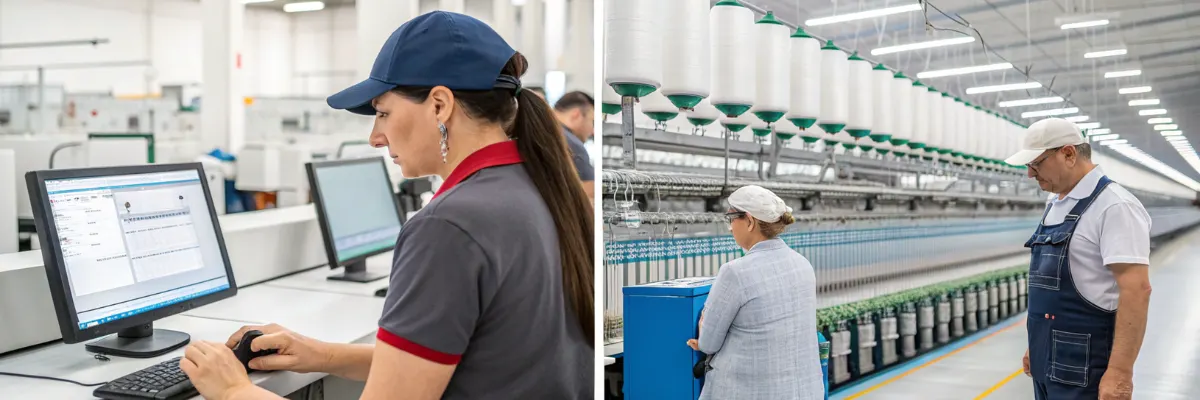
Textile mills form the core of the global textile value chain, converting raw fibers into yarns and fabrics that feed garment, home textile, and technical textile industries.
Modern mills must manage:
- Raw cotton & fiber procurement
- Bale mixing & laydown
- Spinning operations (blow room → ring frame → auto coner)
- Weaving & knitting production
- Dyeing & chemical processing
- Finishing operations (stenter, compactor, calendaring)
- Lot & shade consistency
- Machine efficiency & downtime
- Quality control & lab testing
- Packing, dispatch & compliance
Because textile manufacturing involves continuous processes, high-speed machinery, and chemical-dependent outcomes, manual systems lead to losses, rework, and inconsistent quality. A specialized Textile ERP gives mills real-time visibility, recipe control, efficiency tracking, and full lot traceability—from fiber to finished fabric.
Why Textile Mills Need ERP
Common mill-level challenges include:
- No real-time machine efficiency visibility
- High cotton, yarn & fabric wastage
- Shade variation & dye batch inconsistency
- Lot mix-ups during processing
- Chemical overconsumption
- Poor cross-department planning
- Repeated customer rejections
- Manual QC & audit documentation
- Delayed dispatch & invoicing
A Textile ERP replaces reactive decision-making with process-driven, data-controlled manufacturing.
Key Features of Textile ERP (2026 Edition)
1. Raw Cotton, Fiber & Bale Management
ERP manages:
- Cotton bale procurement
- Fiber properties (length, micronaire, strength)
- Moisture & trash levels
- Bale laydown & mixing plans
- Lot-wise tracking
- Ensures yarn quality consistency from the start.
2. Spinning Production Management
ERP tracks every spinning stage:
- Blow room
- Carding
- Drawing
- Combing
- Simplex
- Ring frame
- Auto coner
Monitors:
- Spindle efficiency
- Breakage rates
- Production per shift
- Waste generation at each stage
- Improves output, reduces waste & downtime.
3. Yarn Packing, Cone Winding & Lot Traceability
ERP controls:
- Cone weight & count
- Yarn count & twist
- Hard waste & soft waste
- Lot & batch assignment
- Packing & labeling
- Full traceability from cotton bale → yarn cone.
4. Weaving & Loom Planning
ERP supports:
- Loom allocation
- Warp & weft planning
- Pick density control
- Loom efficiency tracking
- Stop motion & downtime analysis
- Fabric defect mapping
- Suitable for power looms & automatic looms.
5. Knitting Production Control
ERP tracks:
- Knitting machine RPM
- Loop length
- GSM control
- Fabric roll creation
- Daily production reporting
- Ensures GSM & fabric weight consistency.
6. Dyeing & Processing Management
ERP digitizes the dye house:
- Dye & chemical recipes
- Lab dip creation & approvals
- Batch scheduling
- Machine load planning
- Temperature, time & liquor ratio
- Actual vs theoretical chemical consumption
- Achieves repeatable shades and lower reprocessing.
7. Finishing Operations Tracking
ERP monitors:
- Stenter
- Compactor
- Calendaring
- Raising
- Heat setting
- Tracks speed, temperature, tension & shrinkage parameters.
- Delivers uniform fabric finish and stability.
8. Quality Control (Yarn & Fabric)
ERP records standardized QC tests:
- Count CV%
- Strength & elongation
- GSM & width
- Color fastness
- Shrinkage
- Pilling & tear strength
- Shade variation
- QC approvals & rejections fully traceable.
9. Packing, Baling & Dispatch Management
ERP manages:
- Fabric roll packing
- Bale/carton creation
- Barcode & lot labels
- Customer-specific packing norms
- Dispatch planning & delivery challans
- Faster, error-free dispatch.
10. Costing, MRP & Production Planning
ERP calculates:
- Yarn cost per kg
- Fabric/process cost per meter
- Dye & chemical cost
- Labour & overhead
- Machine running cost
- Enables accurate pricing & margin control.
End-to-End Textile ERP Workflow
Raw Cotton Procurement & Bale Mixing
Inspection → Laydown → Mix creation
Spinning
Blow room → Carding → Drawing → Combing → Ring frame → Auto coner → Yarn packing
Weaving / Knitting
Warping → Loom/Knitting → Greige fabric
Dyeing & Processing
Lab dip → Recipe approval → Dyeing → Washing → Drying → Finishing
Quality Control
Yarn & fabric testing → Approval/rejection
Packing & Dispatch
Roll/bale packing → Labeling → Shipment
Challenges vs ERP Solutions
| Textile Challenge | ERP Solution |
|---|---|
| High wastage | Stage-wise waste tracking |
| Shade mismatch | Recipe & lab dip control |
| Machine downtime | Efficiency & stoppage analytics |
| Lot mix-ups | Lot & barcode tracking |
| QC inconsistency | Standardized test templates |
| Production delays | Real-time planning & scheduling |
Industries Using Textile ERP
- Spinning mills
- Weaving mills
- Knitting factories
- Dyeing & processing houses
- Composite textile mills
- Technical textile units
Benefits of Textile ERP
- Consistent yarn & fabric quality
- Reduced dyeing rework
- Lower raw material wastage
- Improved machine utilization
- Complete lot & shade traceability
- Faster order completion
- Accurate costing & pricing
- Better production planning
Why Choose 100xERP for Textile Mills?
100xERP is designed for high-volume, process-driven textile manufacturing, offering:
- Cotton bale & fiber management
- Spinning efficiency dashboards
- Loom & knitting production planning
- Dye house recipe & lab dip control
- Finishing machine tracking
- Fabric inspection & QC
- Packing & dispatch automation
- Costing, accounts & GST integration
- Suitable for standalone units to large composite mills.
FAQ – ERP for Textile Mills
Q1. Can ERP track machine efficiency?
Yes — spindle, loom & knitting machine efficiency dashboards included.
Q2. Does ERP manage dye recipes & lab dips?
Yes — complete recipe storage, approvals & batch parameter tracking.
Q3. Can ERP handle spinning, weaving, knitting & dyeing together?
Yes — all processes run in one integrated system.
Q4. Is ERP suitable for composite textile mills?
Yes — full end-to-end integration from fiber to finished fabric.