
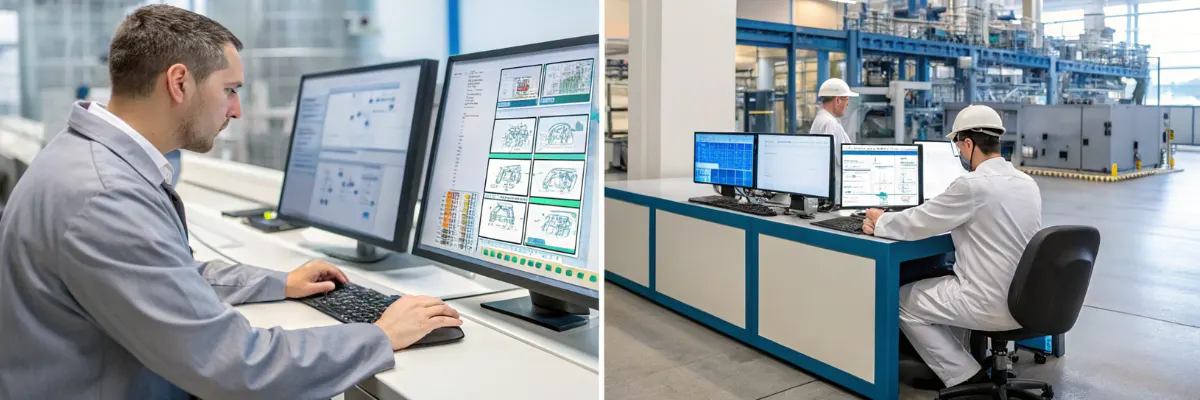
Chemical and process manufacturing industries operate in high-risk, high-precision environments where even small deviations in formulation, temperature, or handling can lead to quality failures, safety incidents, or regulatory violations.
Manufacturers across paints, resins, adhesives, solvents, agrochemicals, dyes, lubricants, specialty chemicals, and intermediates must manage:
- Complex formulations
- Controlled batch processing
- Hazardous raw materials
- Strict quality parameters
- Regulatory compliance (SDS, GHS, REACH, ISO)
- Traceability & recall readiness
- Waste, effluent & emission control
Manual systems and spreadsheets cannot handle this complexity reliably. A dedicated Chemical & Process Manufacturing ERP provides controlled formulations, batch-level traceability, safety governance, QC integration, and audit-ready compliance.
Why Chemical & Process Manufacturers Need ERP
Common operational challenges include:
- Manual formulation & scaling errors
- Batch-to-batch quality variation
- Unsafe handling of hazardous materials
- No visibility into reaction parameters
- QC delays affecting dispatch
- Regulatory non-compliance risks
- Poor waste & by-product tracking
- Inaccurate batch costing
- Difficulty meeting customer specifications
Key Features of Chemical ERP (2026 Edition)
1. Recipe & Formulation Management
ERP enables:
- Multi-level formulations
- Percentage & ratio-based compositions
- Density, viscosity & solids-based adjustments
- Formula version control
- Approval & change control workflow
- Restricted access for sensitive recipes
- Automatic batch size scaling
- Ensures consistent formulation across all batches.
2. Batch Manufacturing & Process Control
ERP manages full batch lifecycle:
- Raw material charging
- Mixing & blending
- Heating / cooling cycles
- Reaction time tracking
- Catalyst & additive dosing
- Filtration & settling
- Parameter deviation logging
- Reduces batch failures and reprocessing.
3. Chemical Raw Material Inventory Management
Tracks chemical-specific attributes:
- CAS number
- Hazard class & GHS symbols
- Flash point
- Shelf life & expiry
- Storage conditions
- Compatibility rules
- Lot & batch numbers
- Improves safety and regulatory compliance.
4. Quality Control & Laboratory Integration
QC tests managed digitally:
- pH
- Viscosity
- Density
- Purity
- Moisture
- Shade / color
- Stability
- Surface tension
- Flash point
- Results are linked directly to batches with approval/rejection logic.
- Faster QC release, fewer dispatch delays.
5. Regulatory Compliance & SDS Management
ERP supports:
- SDS / MSDS repository
- GHS & hazard labeling
- REACH & BIS compliance
- ISO 9001 / 14001 documentation
- Batch COA generation
- Audit trails & electronic approvals
- Audit-ready at all times.
6. EHS (Environment, Health & Safety) Module
Covers:
- PPE compliance tracking
- Safe storage & segregation rules
- Fire & explosion risk management
- Incident & near-miss reporting
- ETP (Effluent Treatment Plant) logs
- Emission & waste monitoring
- Neutralization & disposal records
- Creates a safer, compliant plant environment.
7. Packaging, Drum Filling & Labeling
ERP controls:
- Drum, barrel & container filling
- Variable pack sizes
- UN & hazard labels
- Barcode / QR-coded drums
- Palletization tracking
- Transport safety documents
- Prevents dispatch errors and improves traceability.
8. Tank Farm, Silos & Pipeline Management
ERP tracks:
- Tank level monitoring
- Transfer logs
- Pump usage
- Mixing vessel allocation
- Temperature & pressure readings
- Ensures smooth, contamination-free liquid handling.
9. End-to-End Traceability
Complete forward & backward tracking:
- Raw material lot → Batch → Packaging → Customer
- Essential for recalls, audits, and customer complaints.
10. Costing, Yield & MRP
ERP calculates:
- Batch-wise raw material cost
- Energy & utility usage
- Labour & overhead allocation
- Yield loss & wastage
- By-product & scrap value
- Enables accurate pricing and margin control.
End-to-End Chemical ERP Workflow
Formulation Creation & Approval
Chemist creates recipe → Reviewed → Locked
Raw Material Procurement
RM ordered → GRN → Hazard data captured
Batch Planning
Production order → RM issue → Tank allocation
Batch Manufacturing
Mixing → Reaction → Parameter logging
Quality Control
Sampling → Lab testing → Approval / adjustment
Packaging & Labeling
Drum filling → UN labeling → Palletization
Dispatch & Transport
Safety documents → Delivery → Customer acknowledgment
Challenges vs ERP Solutions
| Challenge | ERP Solution |
|---|---|
| Batch inconsistency | Controlled formulation & parameter logs |
| Safety risks | SDS + EHS enforcement |
| QC delays | Integrated lab workflows |
| Compliance gaps | Audit trails & documentation |
| Waste mismanagement | ETP & waste tracking |
| Cost leakage | Batch-wise costing & yield analysis |
Industries Using Chemical ERP
- Paints & coatings
- Adhesives & resins
- Solvents & petrochemicals
- Agrochemicals & fertilizers
- Dyes & pigments
- Lubricants & oils
- Cleaning & disinfectants
- Specialty & fine chemicals
Benefits of Chemical ERP
- Safe handling of hazardous materials
- Consistent batch quality
- Reduced rework & wastage
- Faster QC release
- Strong regulatory compliance
- Accurate costing & pricing
- Full lot traceability
- Improved production planning
Why Choose 100xERP for Chemical & Process Manufacturing?
100xERP is engineered for risk-controlled, batch-driven chemical environments, offering:
- Advanced formulation & version control
- Batch manufacturing automation
- QC & laboratory integration
- SDS & compliance repository
- Hazardous material inventory
- EHS & ETP tracking
- Drum filling & labeling workflows
- Real-time costing & MRP
- GST & accounts integration
- Suitable for SMEs, specialty chemical units, and large process plants.
FAQ – ERP for Chemical & Process Manufacturing
Q1. Can ERP store SDS / MSDS documents?
Yes — full SDS library with hazard classification & access control.
Q2. Does ERP record batch process parameters?
Yes — temperature, time, mixing speed & pressure logs included.
Q3. Can ERP track hazardous material storage locations?
Yes — location-based tracking with safety alerts.
Q4. Can ERP manage multi-stage chemical reactions?
Yes — supports complex, multi-phase batch processes.