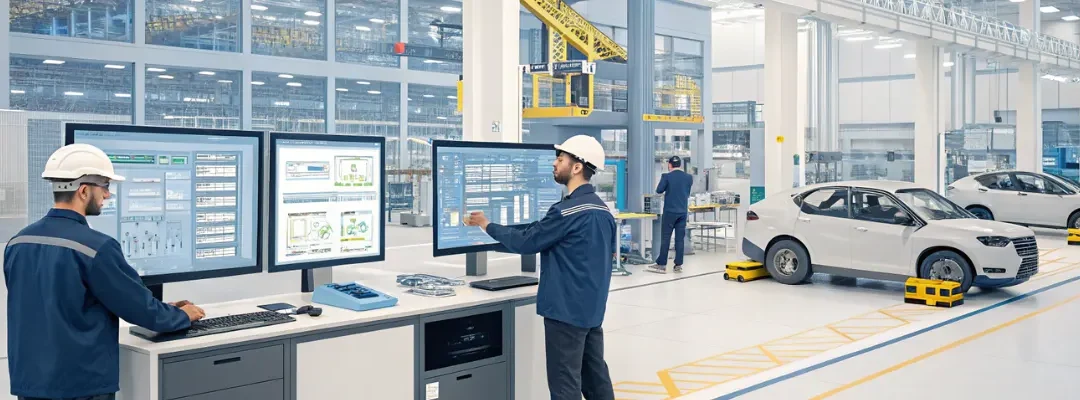
Automotive component manufacturers operate in one of the most demanding manufacturing ecosystems. Every part supplied to an OEM or Tier-1 customer must meet:
- Tight dimensional tolerances
- Material & metallurgical specifications
- Zero-defect quality expectations
- Full backward & forward traceability
- Strict delivery schedules (JIT / Kanban)
- Complete compliance with IATF 16949
Production typically involves multi-stage, process-intensive operations, including:
- CNC machining
- Forging & casting
- Heat treatment
- Grinding & finishing
- Assembly
- Chemical & mechanical testing
- Tooling, die & gauge management
- PPAP, APQP, PFMEA & Control Plans
- OEM audits & customer scorecards
Manual systems, spreadsheets, and disconnected software cannot support this complexity. A specialized Automotive ERP ensures process stability, quality consistency, compliance, and traceability—from raw material heat number to finished part dispatch.
Why Automotive Component Manufacturers Need ERP
Common industry challenges include:
- High rejection & rework cost
- No heat number / lot traceability
- Inconsistent CNC program & tool usage
- Poor control over heat treatment parameters
- Manual inspection records (audit risk)
- Delays in PPAP approval
- Tool breakage & unplanned downtime
- Difficulty meeting JIT & Kanban schedules
- Non-compliance with IATF 16949 documentation
An Automotive ERP replaces manual dependency with standardized, audit-ready, system-driven workflows.
Key Features of Automotive ERP (2026 Edition)
1. Engineering BOM, Routing & Process Planning
ERP supports:
- Multi-level Engineering BOM (EBOM)
- Routing across CNC, forging, casting, grinding, heat treatment
- Alternate machines & processes
- Operation-wise cycle time & setup time
- Auto job card generation
- Ensures controlled, repeatable production flow.
2. Raw Material & Heat Number Traceability
ERP manages:
- Supplier material certificates (chemical & mechanical)
- Heat number / lot number assignment
- GRN → production → dispatch traceability
- Material usage reconciliation
- Mandatory for OEM audits, recalls & warranty claims.
3. CNC Machining Workflow Control
ERP provides:
- CNC program version control
- Tool number & offset mapping
- Tool life monitoring with alerts
- Feed & speed reference storage
- Machine utilization tracking
- Prevents wrong program usage & machining defects.
4. Forging & Casting Production Management
Tracks:
- Die / mould identification
- Furnace temperature logs
- Pouring & cooling parameters
- Trimming & shot-blasting output
- Yield & rejection tracking
- Ensures metallurgical consistency and process repeatability.
5. Heat Treatment Process Control
ERP digitally records:
- Hardening, tempering, annealing
- Carburizing & nitriding cycles
- Furnace temperature & soak time
- Quenching medium
- Hardness test results
- Reduces variation & improves part performance.
6. Quality Inspection & Testing (QA/QC)
ERP covers:
- In-process inspection
- Final inspection
- CMM reports
- Hardness & surface roughness
- Dimensional checks
- Metallurgical testing
- Gauge calibration records
- All inspection data is audit-ready and traceable.
7. PPAP, APQP, PFMEA & Control Plan Management
ERP generates and stores:
- Process flow diagrams
- PFMEA & Control Plans
- PPAP Level-wise documents
- Material certificates
- Inspection & capability reports
- Speeds up OEM approval & re-approval cycles.
8. Tooling, Die & Gauge Management
ERP tracks:
- Tool & die life
- Preventive maintenance
- Breakdown history
- Spare tools inventory
- Gauge calibration schedules
- Reduces downtime & quality drift.
9. Production Planning, MRP & Machine Loading
ERP enables:
- JIT & Kanban scheduling
- Capacity & bottleneck planning
- Real-time WIP visibility
- Machine loading optimization
- Schedule adherence tracking
- Essential for automotive supply chain performance.
10. Dispatch, JIT & OEM Schedule Integration
ERP supports:
- Customer schedule releases
- ASN (Advanced Shipping Notice)
- VDA / AIAG labels
- EDI integration
- Packaging & pallet instructions
- Seamless integration with OEM logistics systems.
End-to-End Automotive ERP Workflow
Raw Material Procurement
Material certificate → GRN → QC → Heat number assignment
Production Planning
Routing → Machine allocation → Job card
Manufacturing
CNC / Forging / Casting / Heat Treatment → WIP tracking
Quality Control
In-process → Final → Lab testing
Assembly & Finishing
Final inspection → Approval
Packaging & Dispatch
VDA labels → ASN → JIT delivery
Customer Feedback & Warranty
Complaint → Root cause → CAPA
Challenges vs ERP Solutions
| Automotive Challenge | ERP Solution |
|---|---|
| High rejection | Standard QC & SPC |
| No traceability | Heat → Job → Dispatch mapping |
| CNC errors | Program & tool control |
| Tool breakage | Tool life tracking |
| Heat treatment variation | Furnace parameter logs |
| Audit failure | Digital PPAP & records |
| JIT delays | Schedule & capacity planning |
Industries Using Automotive ERP
- CNC precision machine shops
- Forging units
- Casting & foundries
- Gear & transmission manufacturers
- Suspension & steering component makers
- Rubber & plastic auto part suppliers
- Electrical & electronic component suppliers
Benefits of Automotive ERP
- End-to-end traceability
- Lower rejection & rework
- Improved machine utilization
- Faster PPAP approval
- Consistent quality output
- On-time JIT delivery
- Reduced compliance risk
- Better cost & margin control
Why Choose 100xERP for Automotive Components Manufacturing?
100xERP is purpose-built for OEM-focused automotive suppliers, offering:
- Multi-stage routing & production control
- CNC, forging & casting workflows
- Heat number & batch traceability
- Heat treatment parameter logging
- QA/QC & lab integration
- PPAP, APQP & audit documentation
- Tool, die & gauge management
- JIT & Kanban dispatch planning
- Accounts & GST integration
- Designed for Tier-1, Tier-2 & Tier-3 automotive manufacturers.
FAQ – ERP for Automotive Component Manufacturing
Q1. Does ERP support PPAP documentation?
Yes — full PPAP levels with auto-generated records.
Q2. Can ERP trace parts back to heat number?
Yes — complete backward & forward traceability.
Q3. Does ERP manage CNC programs and tools?
Yes — program versioning, tool mapping & life tracking.
Q4. Can ERP handle JIT & Kanban schedules from OEMs?
Yes — schedule release, ASN & dispatch automation supported.