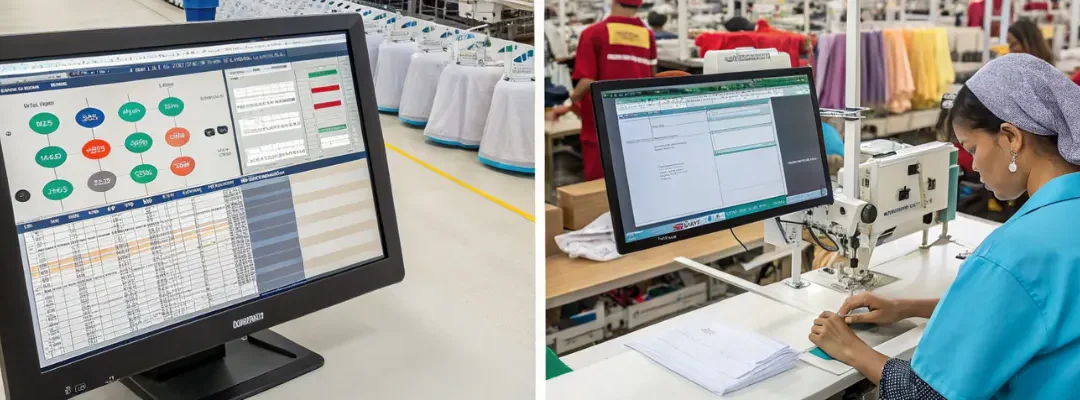
Garment and apparel manufacturing is one of the most operationally complex industries. Each order moves through dozens of interconnected stages—often under tight delivery timelines and frequent buyer changes.
Manufacturers must manage:
- Style development & sampling
- Buyer merchandising & approvals
- Fabric & trims procurement
- Cutting & marker efficiency
- Stitching line balancing
- Washing, printing & embroidery
- Finishing, packing & metal detection
- Quality control (AQL)
- Export documentation & shipment planning
When these processes are handled manually or in silos, factories face cost overruns, delays, rejections, and buyer dissatisfaction. A specialized Garment Manufacturing ERP brings speed, visibility, accuracy, and control—from buyer enquiry to final shipment.
Why Garment & Apparel Manufacturers Need ERP
Common industry challenges include:
- Delayed sample approvals
- Fabric wastage & shrinkage losses
- Trims shortages mid-production
- Poor coordination between merchandising & production
- Low stitching line efficiency
- High rework & quality rejection
- Inaccurate costing & margin leakage
- No real-time production visibility
- Missed shipment deadlines
A Garment ERP eliminates guesswork and replaces it with data-driven, buyer-aligned workflows.
Key Features of Garment Manufacturing ERP (2026 Edition)
1. Style Master, Sampling & Merchandising Control
ERP manages:
- Style creation & revisions
- Tech pack uploads (specs, measurements, sketches)
- Sample request tracking (proto, fit, size set, PPS)
- Buyer approvals & comments
- Merchandiser follow-ups
- Style-wise consumption planning
- Faster approvals, stronger buyer confidence.
2. BOM & Fabric / Trims Consumption Management
ERP controls:
- Fabric types, GSM, width, dye lot
- Trims: buttons, zippers, labels, threads
- Accessories: tags, polybags, cartons
- Auto consumption calculation
- Variance tracking
- Prevents excess buying and shortages.
3. Fabric Purchase, Inspection & Lot Control
ERP tracks:
- Fabric rolls & roll lengths
- Shrinkage & shade variation
- Fabric inspection results (4-point system)
- AQL grading
- Lot-wise storage
- Improves fabric utilization & reduces rejections.
4. Cutting Management & Marker Planning
ERP supports:
- Marker planning & efficiency %
- Lay planning
- Cut order planning (COP)
- Size-ratio distribution
- Cutting wastage analysis
- Bundle generation
- 10–20% fabric savings through optimized cutting.
5. Stitching Production & Line Balancing
ERP provides:
- Operation bulletin (OB)
- SAM calculation
- Line layout planning
- WIP tracking (bundle movement)
- Operator efficiency & productivity
- Bottleneck identification
- Higher output without increasing manpower.
6. Washing, Printing & Embroidery Workflow
ERP tracks:
- Washing recipes & approvals
- Print screen / artwork versions
- Embroidery program versions
- Job-work issue & receipt
- Quality checkpoints
- Consistent finishing quality across lots.
7. Finishing, Packing & Carton Management
ERP manages:
- Ironing & thread trimming
- Measurement checks
- Metal detection (export compliance)
- Size-wise packing
- Carton barcoding
- Packing list generation
- Faster, error-free shipment preparation.
8. Quality Control (In-Line, End-Line & Final)
ERP includes:
- Defect library
- AQL levels
- In-line inspection
- End-line inspection
- Final audit approval
- Measurement templates
- Reduces rework, returns & buyer complaints.
9. Export Documentation & Shipment Planning
ERP auto-generates:
- Commercial invoice
- Packing list
- Delivery challan
- Buyer PO mapping
- Container loading plan
- Export compliance documents
- Ideal for export-oriented garment units.
10. Costing, Margin & Profitability Analysis
ERP calculates:
- Fabric & trims cost
- Labour & SAM cost
- Overhead allocation
- Operation-wise cost
- Cost per piece
- Style-wise margin
- Accurate pricing and healthier margins.
End-to-End Garment ERP Workflow
Buyer Enquiry & Style Creation
Tech pack → BOM → Sample planning
Sampling & Buyer Approval
Sample → Feedback → Final approval
Raw Material Procurement
Fabric & trims → Inspection → Storage
Cutting & Marker Planning
Marker → Cutting → Bundling
Stitching Production
Line execution → WIP tracking → In-line QC
Finishing & Packing
Ironing → Measurement → Packing
Shipment & Export
Carton → Documentation → Dispatch
Challenges vs ERP Solutions
| Industry Challenge | ERP Solution |
|---|---|
| Fabric wastage | Marker efficiency & COP |
| Line inefficiency | SAM & operator tracking |
| Trims shortage | Inventory alerts |
| Rework & defects | AQL-based QC |
| Shipment delays | Automated planning |
| Buyer follow-ups | Merchandising module |
Industries Using Garment ERP
- Garment exporters
- Apparel manufacturing units
- Fashion brands
- Uniform manufacturers
- Knitwear & hosiery factories
- Denim & woven apparel units
Benefits of Garment Manufacturing ERP
- 10–20% reduction in fabric wastage
- Faster sample approval cycles
- Improved line efficiency
- Lower rejection & rework
- Accurate costing & pricing
- On-time shipment delivery
- Stronger buyer relationships
- Complete order visibility
Why Choose 100xERP for Garments & Apparel Manufacturing?
100xERP is purpose-built for export-focused and domestic garment factories, offering:
- Style master & sampling workflows
- Merchandising & buyer tracking
- Marker planning & cutting control
- Line balancing & productivity monitoring
- Washing, printing & embroidery management
- AQL-based QC system
- Export documentation automation
- Costing & profitability analytics
- Accounts & GST integration
- Suitable for small units to large export houses.
FAQ – ERP for Garments & Apparel Manufacturing
Q1. Can ERP calculate fabric consumption accurately?
Yes — based on marker efficiency, size ratio & shrinkage.
Q2. Does ERP support sampling & buyer approvals?
Yes — complete sampling workflow with approval history.
Q3. Can ERP monitor stitching line productivity?
Yes — operator-wise and line-wise efficiency tracking.
Q4. Is ERP suitable for export garment manufacturing?
Yes — includes export documents, packing lists & compliance.